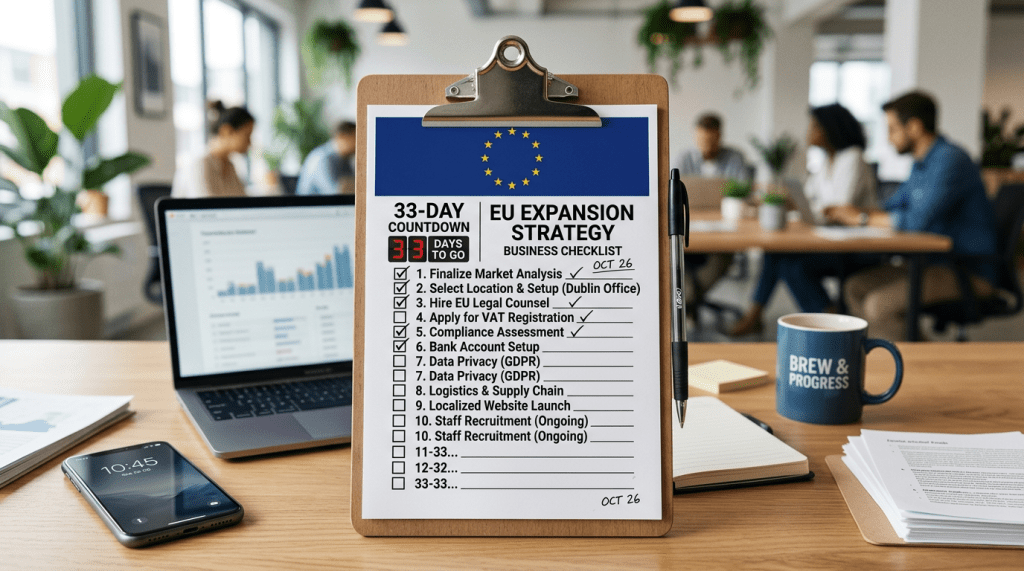
The August 2, 2026 deadline is 33 days away.
Most businesses are not ready. Not because the rules are complicated — but because nobody told them clearly what is actually required right now.
This post gives you that. A practical checklist you can run this week, without a lawyer, without jargon.
What Is Confirmed for August 2 — No Matter What
Before we get to the checklist, one thing needs to be clear.
There is a proposed amendment to the EU AI Act — the Digital Omnibus — that would delay some deadlines. That proposal is not yet law. It is a political agreement. Until it is formally signed and published, the original law applies.
Two obligations are confirmed for August 2, 2026 under every version of the law:
Article 4 — AI Literacy. Every business that deploys or uses AI must ensure staff have sufficient understanding of the AI tools they work with.
Article 50 — Transparency. If you use a chatbot, AI assistant, or any AI that interacts with people, you must tell them they are talking to AI.
These are not delayed. Run the checklist for both.
The Checklist
Step 1: List Every AI Tool Your Business Uses
Start here. You cannot comply with what you have not identified.
Go through every department. Ask your team what tools they actually use — not just what IT approved. Shadow AI is common: employees using ChatGPT, Grammarly, AI scheduling tools, AI customer support bots without central sign-off.
Write it down. Tool name, what it does, who uses it.
This is the starting point for Article 4 compliance.
Step 2: Check Whether Any Tool Talks to Your Customers
Look at your list. Does any tool:
- Handle customer chat or enquiries?
- Send automated messages or emails on your behalf?
- Answer questions on your website?
- Act as a voice assistant or support bot?
If yes — Article 50 applies. You must disclose that users are interacting with AI. This must happen at the start of the interaction, not buried in your terms and conditions.
What this looks like in practice:
A simple line at the start of a chatbot conversation: “You are chatting with an AI assistant.”
An email footer if the email was AI-generated: “This message was drafted with AI assistance.”
It does not need to be dramatic. It needs to be clear and upfront.
Step 3: Train Your Staff — Or Document That You Have
Article 4 does not require a formal training course. It requires that staff have sufficient AI literacy for the context in which they use AI tools.
What this means for most SMEs: your team should understand what each AI tool does, what it cannot do, and where human judgement is still required.
Document it. A short internal session, a written note of what was covered, who attended, and when. That documentation is your evidence if you are ever asked.
No documentation = no compliance, even if your team genuinely understands the tools.
Step 4: Check Your HR and Recruitment Tools
This step matters even if the Omnibus passes.
If your business uses any software that helps screen CVs, rank candidates, score employees, or assist in hiring decisions — that software may fall under the high-risk category in Annex III.
Under the current law, Annex III obligations apply from August 2, 2026. Under the proposed Omnibus, that shifts to December 2027.
But here is the risk: if the Omnibus is not formally signed before August 2, the original deadline stands. You have 33 days and no certainty.
The minimum action now: identify whether you use any such tools and ask your vendor whether they have carried out a conformity assessment under the EU AI Act.
Step 5: Update Your Vendor Contracts
If you use third-party AI tools — and most businesses do — your contracts with those vendors should now include AI Act obligations.
Specifically: who is responsible if the tool causes a compliance breach? What documentation can the vendor provide? Are they registered in the EU AI Act database if required?
You do not need to renegotiate immediately. But you need to raise the question. Add it to your next vendor review.
What Happens If You Do Nothing
The EU AI Act is enforced at national level. Each member state has a designated authority. Norway, as an EEA member, will implement equivalent obligations.
Fines for non-compliance with transparency obligations (Article 50) can reach €15 million or 3% of global annual turnover — whichever is higher.
For most SMEs, enforcement will not begin on August 3. But the obligation begins on August 2. And being able to demonstrate you took reasonable steps matters significantly in any investigation.
Where to Go From Here
If you want to move faster than this checklist allows, the tools already exist.
The AI 4 Act Simple handbook covers the full EU AI Act in plain language — 70 pages, no legal training required. It is built for business owners and operations teams who need to understand the regulation and act on it.
👉 https://frelih.gumroad.com/l/pzqly
If you need to get your staff trained and documented before August 2, the AI Literacy Rapid Kit gives you everything in one download — training deck, acceptable use policy, and action roadmap.
👉 https://frelih.gumroad.com/l/jprtb
33 days is enough time. Start with the checklist.
Ales Frelih writes about EU AI Act compliance for SMEs — practical tools, no legal jargon. Based in Norway.
 Ales Frelih
Leave a comment