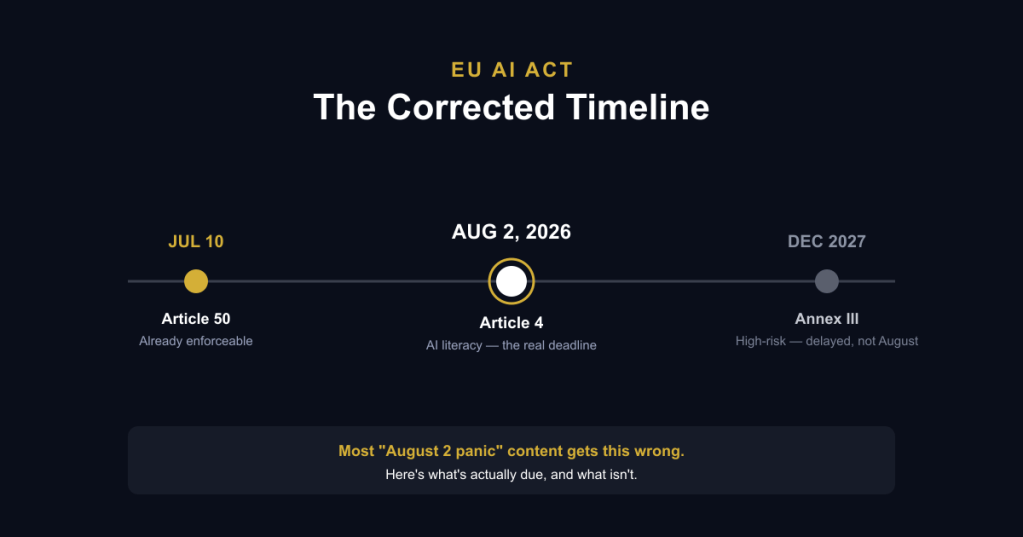
Most companies assume the EU AI Act is a future problem.
They are waiting for the big compliance deadline, watching the news, and quietly hoping nothing applies to them yet.
Article 50 arrives on 2. August 2026. Seven weeks away. And it does not care whether you knew it was coming.
If you have a chatbot on your website, or if you publish images, videos, or audio made with AI tools, you are in scope. The question is not whether you need to act. The question is whether you have five minutes to do it this week.
—
## What Article 50 Is Actually About
The previous post in this series covered Article 4 — the obligation to ensure your team understands how to use AI tools responsibly. That one is about internal documentation.
Article 50 is different. It faces outward. It governs what you tell your customers, your website visitors, your audience.
The law is built around one simple idea: people have a right to know when they are interacting with AI, and when the content they are consuming was made by AI. That sounds reasonable because it is.
Article 50 creates two separate obligations. Most businesses will be affected by one or both.
—
## Obligation One: Chatbot Disclosure
If you deploy any AI system that interacts with people in real time — a chatbot on your website, a voice assistant, an AI customer service agent — you must inform users, clearly and at the start of the interaction, that they are talking to an AI.
The requirement applies unless it is obvious from context. A button on your website that says “Chat with our AI assistant” probably satisfies it. A widget that opens with “Hi, I’m Maya! How can I help you today?” probably does not — unless Maya is visibly identified as AI somewhere in that same interface.
The rule is specifically about real-time interaction: live chat, voice, instant messaging with AI behind it. It does not apply to your internal workflows. If your customer service team uses ChatGPT to help draft replies before sending them as their own, Article 50 does not cover that. The disclosure obligation is about the customer’s experience, not your team’s toolbox.
—
## Obligation Two: AI-Generated Content Labelling
If you publish content that is generated or significantly manipulated by AI — images, video, audio — you must label it as artificially generated or manipulated.
The label needs to be machine-readable, meaning it should be embedded in the file itself, not just written as a caption. The regulation is designed with the expectation that platforms will eventually read this metadata automatically. Until that infrastructure exists, a visible human-readable disclosure also works and satisfies your obligation today.
There is one explicit exception: satire, parody, and artistic expression, where labelling would harm the artistic intent and there is no risk to public interest. For standard business content — marketing images, product photos, social media posts — the exception does not apply.
—
## Who Actually Needs to Pay Attention
Here is the honest answer: most businesses that use modern AI tools.
If any of the following describes your situation, Article 50 applies to you:
**You have a chatbot on your website.** This includes any AI-powered chat widget — Tidio, Intercom with AI features, a custom ChatGPT integration, Voiceflow, Landbot, or a WhatsApp bot with AI routing.
**You use AI to generate marketing images.** Midjourney, DALL-E, Stable Diffusion, Adobe Firefly, Canva’s AI image generator — any of these trigger the labelling obligation if the images are published externally.
**You produce AI-generated or AI-edited video.** Tools like Sora, RunwayML, HeyGen, Synthesia, or CapCut with AI features all fall in scope.
**You publish AI-generated voice content.** ElevenLabs audio on your website, AI voiceover in a YouTube video, a synthetic voice in a podcast — if it is public, it needs a label.
If none of these currently apply to your business, you are outside Article 50’s scope for now. That changes the moment you add a chatbot widget or use AI to generate your next social post.
—
## What to Do — Chatbot Implementation
This is genuinely simple for most businesses.
**Step one.** List every point where customers interact with your AI. Website chat, WhatsApp bot, email auto-responder with AI drafting, voice systems — any channel where a customer might not know they are talking to a machine.
**Step two.** Add a disclosure at each entry point. It does not need to be elaborate. These three examples all work:
– “You are chatting with an AI assistant.”
– “AI-powered chat — [Your Company] Customer Service”
– “This conversation is handled by AI. For human support, contact us at [email].”
**Step three.** Document it. One line per chatbot: the tool name, the URL or channel, the disclosure text you used, and the date you added it. That is the complete evidence trail for an auditor.
The entire process takes under thirty minutes for a business with one or two chatbot implementations.
—
## What to Do — AI Content Labelling
**Step one.** Set a clear convention for your team. Any AI-generated image used in a social post or on the website gets a caption or alt-text tag that includes “AI-generated image.” Any AI voice audio published publicly gets a note in the description or accompanying text.
**Step two.** For the machine-readable metadata layer, use whatever your tool already supports. Adobe Firefly embeds Content Credentials automatically. Midjourney does not currently do this natively, but you can add machine-readable metadata using C2PA-compatible editors. At minimum, visible human-readable disclosure satisfies your obligation right now.
**Step three.** Add one paragraph to your AI Use Policy — which you should already have from Article 4 compliance — describing your content labelling approach. Something like: “When we publish AI-generated images externally, we label them as such in captions. When we use AI-generated voice in public audio or video content, we disclose this in the description.” That paragraph documents your intent and tells your team what the expectation is.
—
## The Four Mistakes Worth Avoiding
**Mistake one: Using the chatbot’s name as the disclosure.**
Naming your bot “Aria” or “Max” is not a disclosure. The name needs to communicate AI, not merely personify it. “Aria — AI Assistant” works. “Aria” alone does not. Go check every chatbot implementation you have.
**Mistake two: Assuming caption-only disclosure is enough at scale.**
A caption saying “Created with AI” satisfies the human-readable requirement for most businesses. But if you publish AI-generated content at significant volume — a marketing agency creating for multiple clients, an e-commerce site with hundreds of product images — the machine-readable layer becomes increasingly important. Start building that habit now.
**Mistake three: Assuming your AI tool handles labelling automatically.**
Some do. Adobe and Microsoft have invested heavily in C2PA content credentials. Most image generation tools have not implemented this yet. Do not assume your tool is compliant. Check its documentation, and add visible labelling regardless of what the tool does automatically.
**Mistake four: Confusing AI interaction with AI assistance.**
The chatbot rule covers systems that interact with customers in real time. It does not require you to disclose every time your team uses AI internally. The distinction matters: AI helping your staff is a workflow question. AI talking to your customers is a transparency obligation.
—
## How to Think About Risk
Article 50 enforcement in the first year will focus on visible, obvious violations. A business deploying a chatbot with no disclosure whatsoever. A public figure using AI-generated deepfakes without labelling.
Small businesses using a website chatbot are not the primary enforcement target in 2026.
That said, the obligation exists from day one. Adding two lines to a chat widget configuration takes five minutes. The more realistic risk for a small business is not a regulatory fine — it is a complaint from a customer who felt misled, or a B2B client whose own compliance programme extends to their suppliers. A visible disclosure is cheap insurance against both.
—
## The Bigger Picture
This post and the previous one have covered the two Article 4 and Article 50 obligations that affect most SMEs before 2. August 2026.
The next significant compliance milestone is 2 December 2027, when requirements for high-risk AI systems under Article 6 and Annex III come into force. High-risk covers a narrow category: AI used in hiring decisions, creditworthiness assessment, biometric categorisation. The majority of small businesses are not in scope for December 2027.
The post after next will cover how to check whether any AI tools you use fall into high-risk categories — and what that actually means for your business if they do.
—
**Want to confirm exactly what applies to your situation before August?**
The free checklist walks through both Article 4 and Article 50 obligations, with a short questionnaire to help you identify which tools and channels trigger each requirement.
→ Free checklist (German): [frelih.gumroad.com/l/slwzch](https://frelih.gumroad.com/l/slwzch)
→ Free checklist (French): [frelih.gumroad.com/l/bghydm](https://frelih.gumroad.com/l/bghydm)
If you want done-for-you templates — the AI Use Policy with the content labelling section already drafted, chatbot disclosure text in multiple languages, and a training records register — those are in the full compliance kits.
→ EU AI Act Compliance Kit — EUR 149 (German): [frelih.gumroad.com/l/mjsaqg](https://frelih.gumroad.com/l/mjsaqg)
→ Kit Conformité Loi IA — EUR 149 (French): [frelih.gumroad.com/l/xdyenu](https://frelih.gumroad.com/l/xdyenu)
—
*Aleš Frelih writes about EU AI Act compliance, forex trading, and AI tools from a desk in Norway. This article is informational. Consult a qualified lawyer before relying on it for compliance decisions.*
 Ales Frelih
Leave a comment