The EU AI Act deadline nobody is talking about (and it is not 2 August)
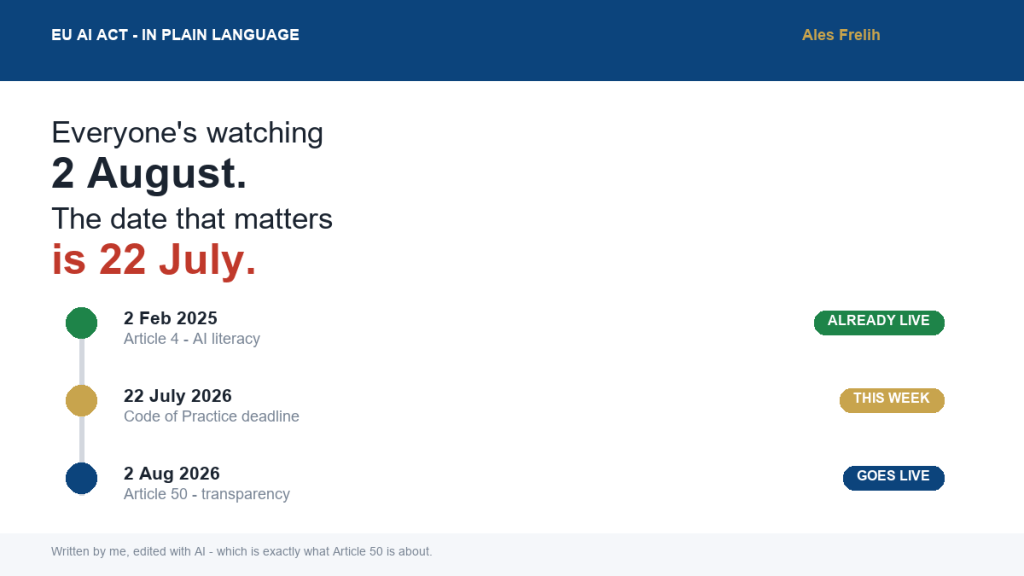
Open LinkedIn this week and you will see the same countdown everywhere: 2 August 2026, the day Article 50 of the EU AI Act starts to apply. It is a real date. It matters. But if that is the only date on your radar, you have already missed a more urgent one.
## The date that actually closes this week: 22 July 2026
On 22 July 2026, the window closes to sign the EU AI Office’s **Code of Practice on Transparency of AI-Generated Content**.
This is not a bureaucratic footnote. Signing gives you a **presumption of conformity** with your Article 50 transparency obligations. In practice, that shifts the burden of proof toward the regulator instead of your business. If a market surveillance authority comes knocking, a signatory starts from “presumed compliant.” A non-signatory starts from “prove it.”
For a small company with no legal department, that difference is the whole game. And almost nobody in the SME world is talking about it, because the headlines are all pointed at August.
## What actually applies on 2 August 2026
When Article 50 does start to apply, the core transparency rules are straightforward:
– If your business runs a **chatbot**, you must tell people they are talking to an AI.
– If you **publish AI-generated content** (text, image, audio, video), it has to be marked as AI-generated, in a way machines can detect.
Get it wrong and the penalty is up to **15 million euro or 3% of global annual turnover**, whichever is greater, enforced by national authorities in each member state.
Note what did *not* happen. In May 2026 the EU agreed to push the **high-risk** obligations back to December 2027. That was real relief, and it is also why a lot of people stopped reading. But the transparency rules under Article 50 were not delayed. Neither was the obligation I think most SMEs are quietly breaking right now.
## The gap that is already live: Article 4
Article 4 — the **AI literacy** obligation — has been in force since **2 February 2025**. It requires that anyone providing or deploying AI ensures their staff have a “sufficient level of AI literacy” for their role.
Read that again. It is not a future deadline. It is current law. If your team uses AI tools at work — and in 2026, whose team does not — and you have run no structured training, no policy, no record of it, you do not have a “to-do for August.” You have a live compliance gap today.
This is the part I find genuinely frustrating. The countdown culture around 2 August makes compliance feel like a single future event you can sprint at. It is not. Some of it is already overdue.
## What I would do this week
Three questions, in order:
1. **Sign the Code of Practice before 22 July 2026** if you produce or deploy generative AI. It is the cheapest legal protection on the table.
2. **Check what you ship for 2 August.** Any chatbot or AI-generated content that faces the public needs a disclosure plan.
3. **Look honestly at Article 4.** Have you actually trained your people, or have you assumed they are fine? If it is “assumed,” that is where to start — because it is the obligation you are most likely already failing.
The businesses that treat August as a starting line will be late. The ones that already fixed literacy and signed the Code this week will spend August calm.
—
*This article was written by me and edited with AI. Which, fittingly, is exactly the kind of disclosure Article 50 is about. It is general information on the EU AI Act, not legal advice.*
—
## Notes
– Status: DRAFT – Ales reviews + publishes manually via Brave.
– Rule check: EUR only · “I” not “we” · no “clients/specialist” · dates written out · AI-edited disclosure included.
– Sources: EU Commission (Code of Practice signatory deadline 22 July 2026); Article 50 (€15M/3% fine, applies 2 Aug 2026); Article 4 in force 2 Feb 2025; high-risk delayed to Dec 2027 (Digital Omnibus, political agreement 7 May 2026).
– Suggested first-comment / CTA on social share: free self-check + Handbook €35.


Leave a Reply