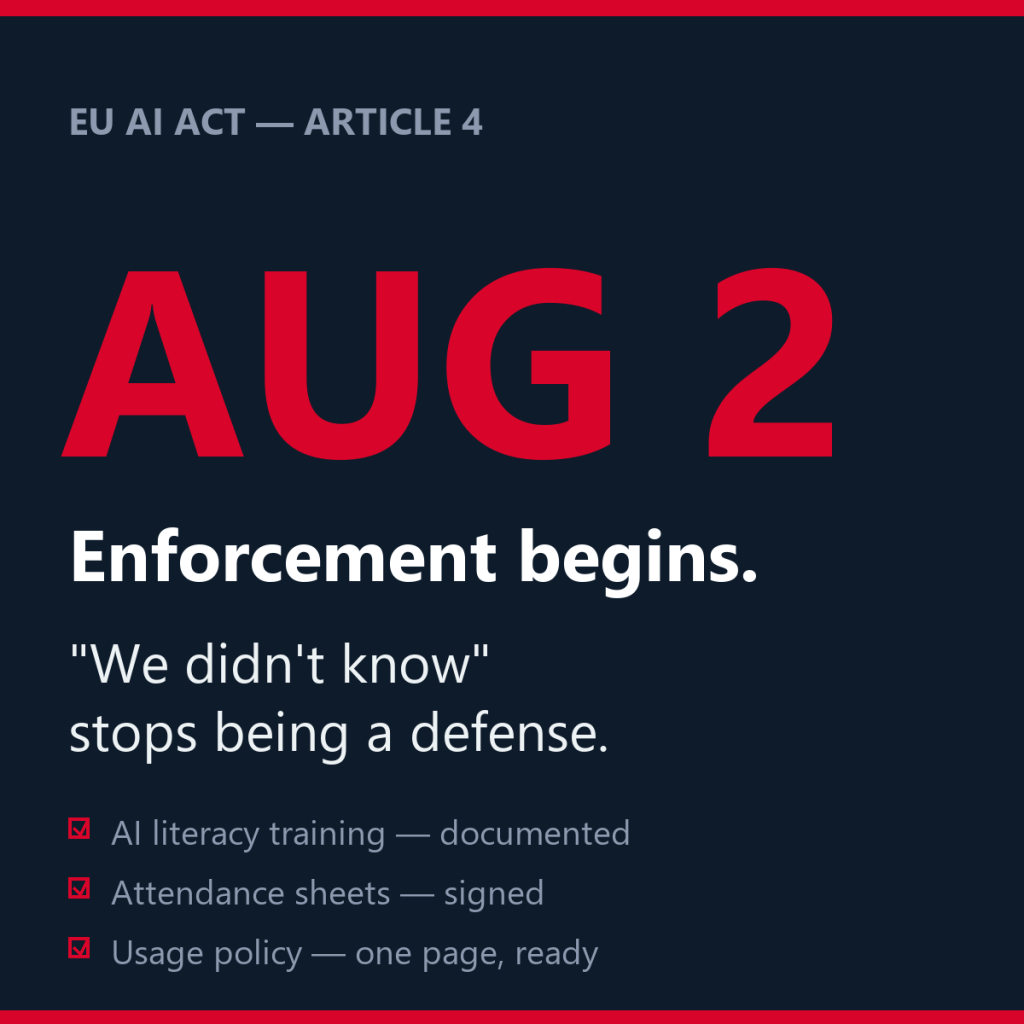
On Saturday, August 2, 2026, enforcement begins for one of the most overlooked provisions of the EU AI Act: Article 4 — the AI literacy obligation.
Most companies spent 2025 worrying about prohibited AI systems and high-risk classifications. Meanwhile, Article 4 quietly applies to almost every business in Europe — including yours, if your team so much as drafts emails with ChatGPT.
What Article 4 actually says
Article 4 requires providers and deployers of AI systems to ensure a sufficient level of AI literacy among staff who operate or use AI on their behalf — taking into account their technical knowledge, experience, education, and the context the AI is used in.
Translated from legal language: if your people use AI at work, you must train them — and be able to prove it.
Who this applies to
- The marketing team generating images with AI tools
- HR departments using AI anywhere in recruitment (this doubles into high-risk territory under Annex III)
- Finance staff pasting data into chatbots
- Any employee with a ChatGPT, Copilot, or Gemini tab open right now
There is no small-company exemption. A 5-person agency in Oslo falls under Article 4 the same way a Frankfurt bank does.
What “AI literacy” means in practice
Regulators look for four things:
- Capability awareness — staff understand what the tool can and cannot do
- Risk awareness — hallucinations, bias, data protection, confidentiality
- Contextual rules — what is allowed and forbidden in YOUR workplace
- Documentation — training dates, content covered, who attended, signatures
Points 1–3 are an afternoon of training. Point 4 is what saves you in an audit.
What happens if you ignore it
Nobody expects dawn raids on August 2. Enforcement of Article 4 will mostly surface when something else goes wrong: a data leak traced to a chatbot, a discrimination complaint about an AI-screened hiring process, a customer harmed by AI-generated output.
At that moment, the first document request is: show us your AI literacy measures.
Having them: a footnote. Not having them: negligence, in writing, with AI Act fines reaching €35 million or 7% of global turnover at the top end.
The one-afternoon fix
You need three documents and one meeting:
- A short training deck covering capabilities, risks, and your internal rules
- An attendance sheet with signatures and date
- A one-page AI usage policy staff can actually read
- A calendar reminder to repeat it annually and for new hires
You can build this yourself — or take the shortcut I built for European SMEs: the AI Literacy Rapid Kit (€49) contains the training slides (EN + DE), attendance templates, and the documentation checklist, ready to deploy in one afternoon. The €29 Starter Kit covers the audit checklist alone.
Either way: be able to answer “do we have this?” with yes before Saturday.
Aleš Frelih builds practical EU AI Act compliance tools for European SMEs. Not legal advice — practical preparation.
 Ales Frelih
Leave a comment